This material is based on data available as of the date presented and is provided solely for informational purposes. It does not constitute investment advice, a recommendation, an offer to sell, or a solicitation to buy any security or investment product. Past performance is not indicative of future results.
What happened on Friday:
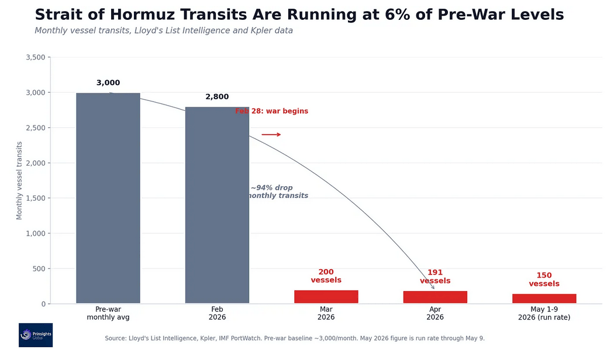
- The Trump–Xi summit failed to achieve a major breakthrough on reopening or stabilizing the Strait of Hormuz.
- Brent crossed $109 per barrel.
- A global bond selloff pushed the 10-year Treasury yield to 4.5%.
- The S&P 500 fell more than 1%, led by declines in tech stocks.
Yield Curve Repricing
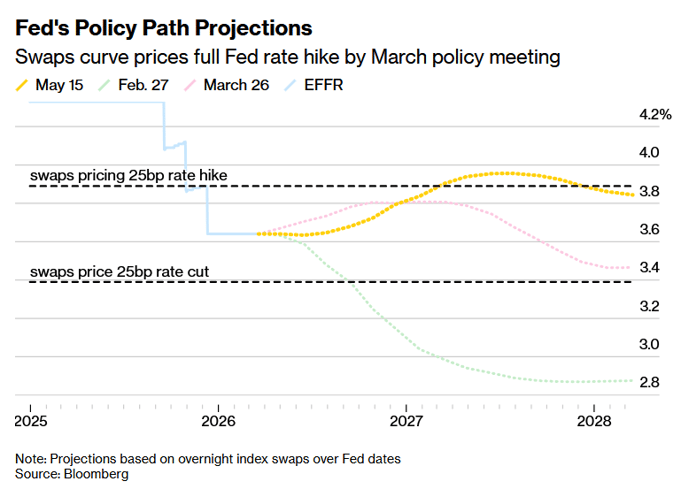
Rate-cut optimism has faded as the Iran conflict fuels inflationary pressures. In April,
- Core CPI rose 0.38% month-over-month (=4.6% if annualized)
-
Core PPI increased 1.04% month-over-month (=13.2% if annualized).
Markets are now pricing in no rate cuts for 2026 and a rising probability of policy tightening.
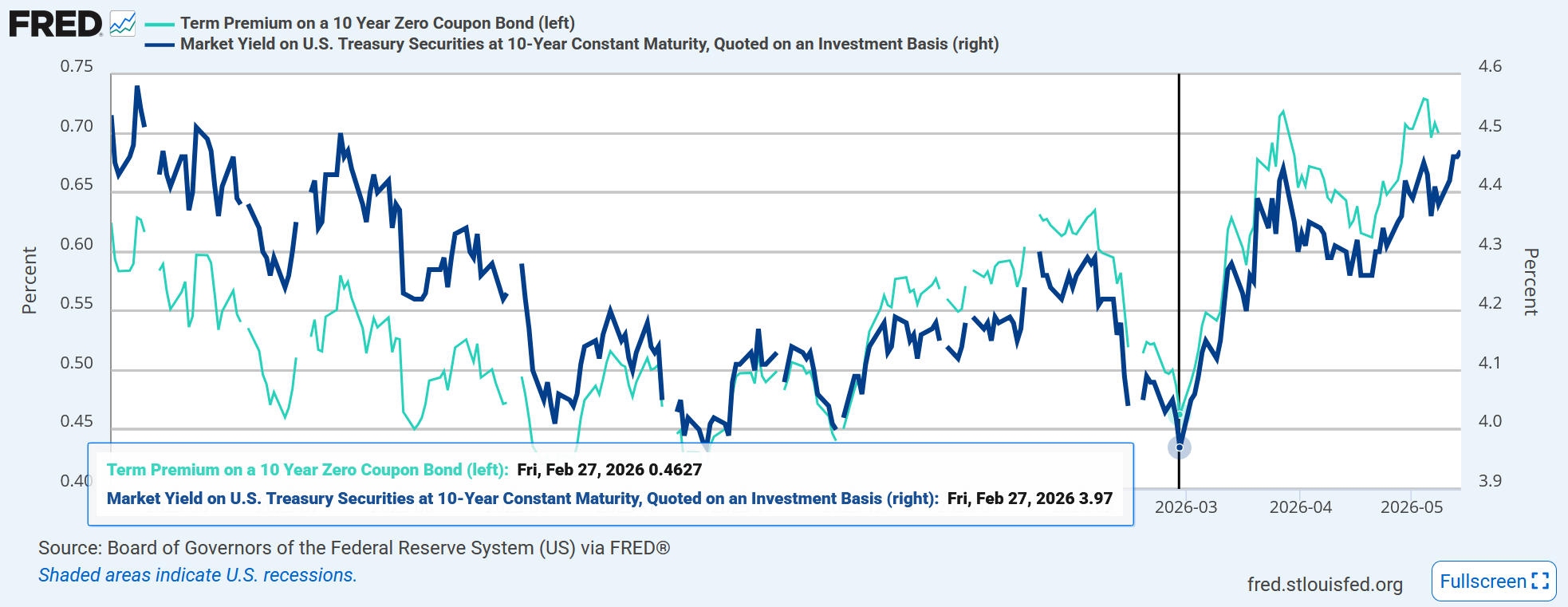
On the longer end of the curve, the 10yr Treasury yield has risen 50bp since February 28:
- 27bp attributable to an increase in expected future short-term rates
- 23bp attributable to an increase in the term premium (reflecting elevated geopolitical risk as well as greater inflation and fiscal uncertainty).
Investment Implications
Bonds: Duration Bets Are Always Risky—More So Today
In general, making duration timing bets is difficult because macro forecasting is far more uncertain than most investors realize.
- In 2023–2024, the recession consensus championed by Wall Street pundits—including Morgan Stanley’s Chief U.S. Equity Strategist and CIO—never materialized.
- In 2025, fears that tariffs would trigger a renewed inflation spike and recession also proved overstated.
In both episodes, intermediate-duration bond funds such as VCIT outperformed floating-rate funds like FLOT as markets priced in rate cuts, only to subsequently underperform as rate expectations were delayed or reversed.

Source: Morningstar. As of 5/15/2026. For illustrative purposes only. Not representative of an actual portfolio allocation or investment recommendation.
Forecast errors create volatility, while the effects of tactical duration positioning often wash out over time even with positive convexity. For long-term fixed-income investors, the rule of thumb is that starting yield, not duration, is the most important driver of total return.
Equities: Secular Growth Leaders Likely Outperform
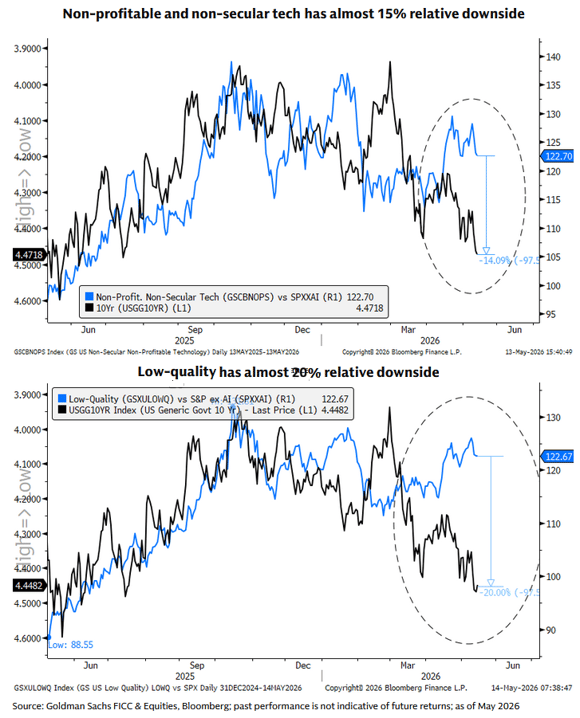
In a potential environment of higher inflation, higher rates, and slower growth, companies with strong secular growth, pricing power, and high returns on capital may still compound earnings fast enough to offset higher discount rates. By contrast, companies with low growth and bond-like cash flows may become less attractive, as investors can now earn 4–5% through fixed income with substantially lower risk. With the cost of capital moving higher, a downward repricing of low-growth, unprofitable, and low-quality equities may be underway.