
March Performance Overview
In March, the Size & Style Responsive (SSR) Tax-Aware portfolio lost 5.1%, which was similar to the S&P 1500's return of -5.0%.
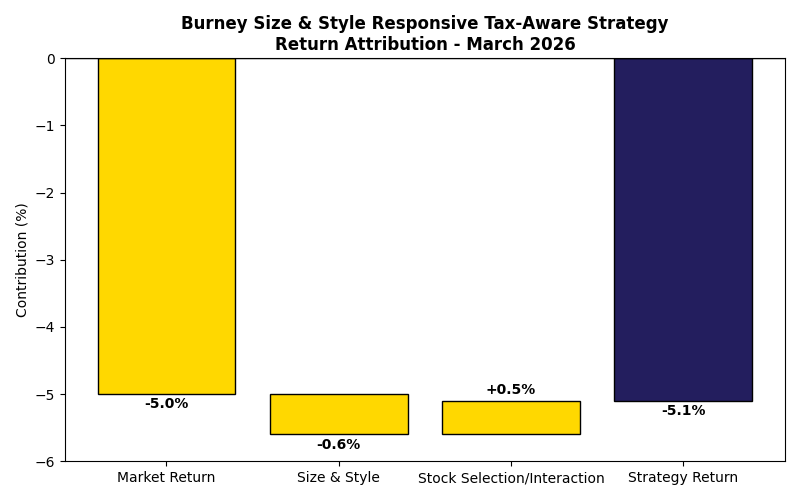
Size and style were a drag on performance but stock selection and the interaction between stock selection and size and style helped offset the loss from size and style alone. Below is a breakdown of the performance attribution:
- Market Return: -5.0%
- Size & Style Effects: -0.6%
- Stock Selection/Interaction Effect: +0.5%
- Strategy Return: -5.1%
Portfolio Construction & Allocation Framework
Our portfolio continues to follow the size and style allocation guidance implemented in mid-2025, which reflects our systematic factor signals and long-term diversification objectives.
Overall Portfolio
The table below shows the allocation of the portfolio by size and style.
Size and Style Allocation Guidance
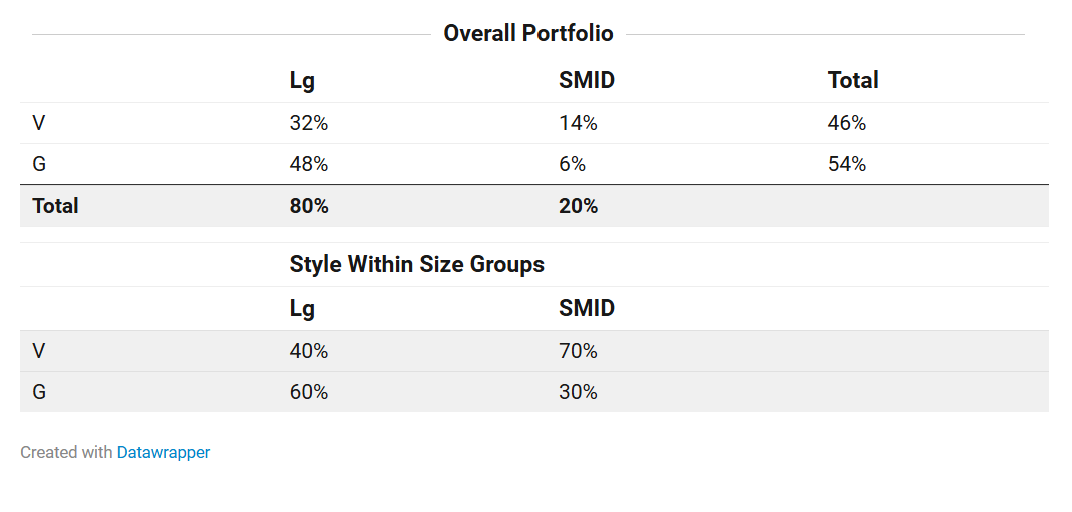
This framework defines:
- Overall exposure to Large vs. SMID companies
- The split between Value and Growth within each size segment
These targets evolve as factor signals change, but remain anchored to maintaining diversified exposure across market regimes.
Size Factor Signal
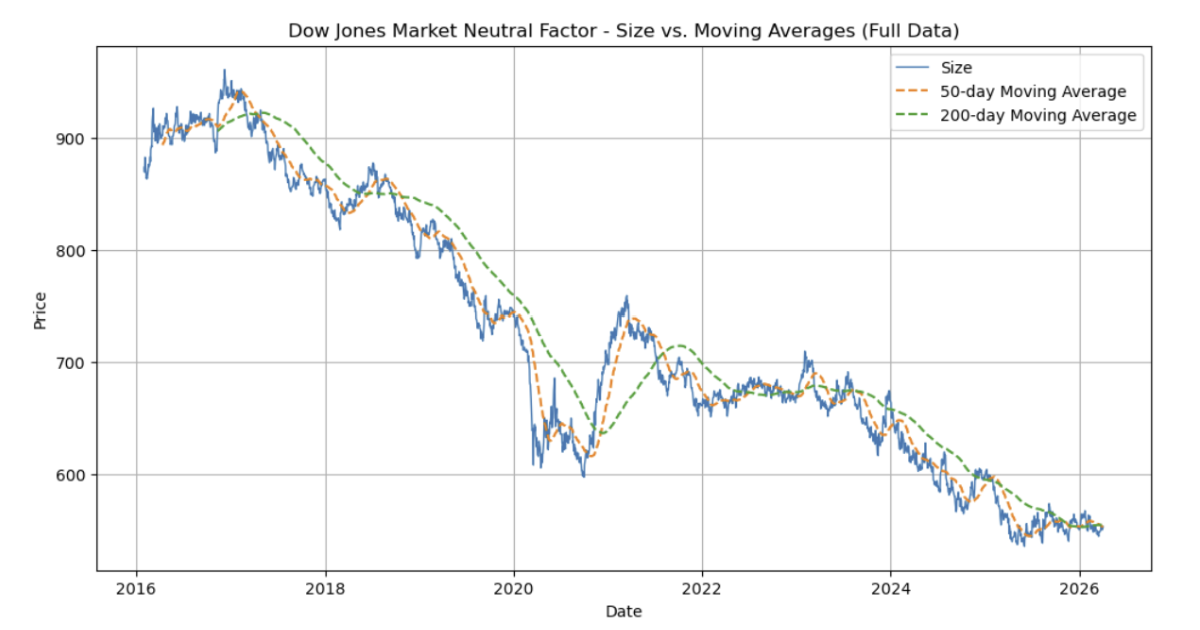
The size signal continued to weaken in March. Smaller companies continue to underperform larger companies on a relative basis, though the gap between them is shrinking. Throughout most of 2025, the Mag 7 drove market returns, but this trend began to reverse in 2026. In March of 2026, however, the conflict in Iran caused a market retreat as investors pondered the impacts of the conflict and disruptions to oil supply on the consumer and the global economy. The S&P 500 was down -5.1%. At the same time, the S&P SmallCap 600 was down 4.1% and the S&P MidCap 400 was down 4.2%. While the entire market was in retreat, large caps continued to underperform relative to small and midcap, which highlights the 2026 trend of lackluster large cap performance.
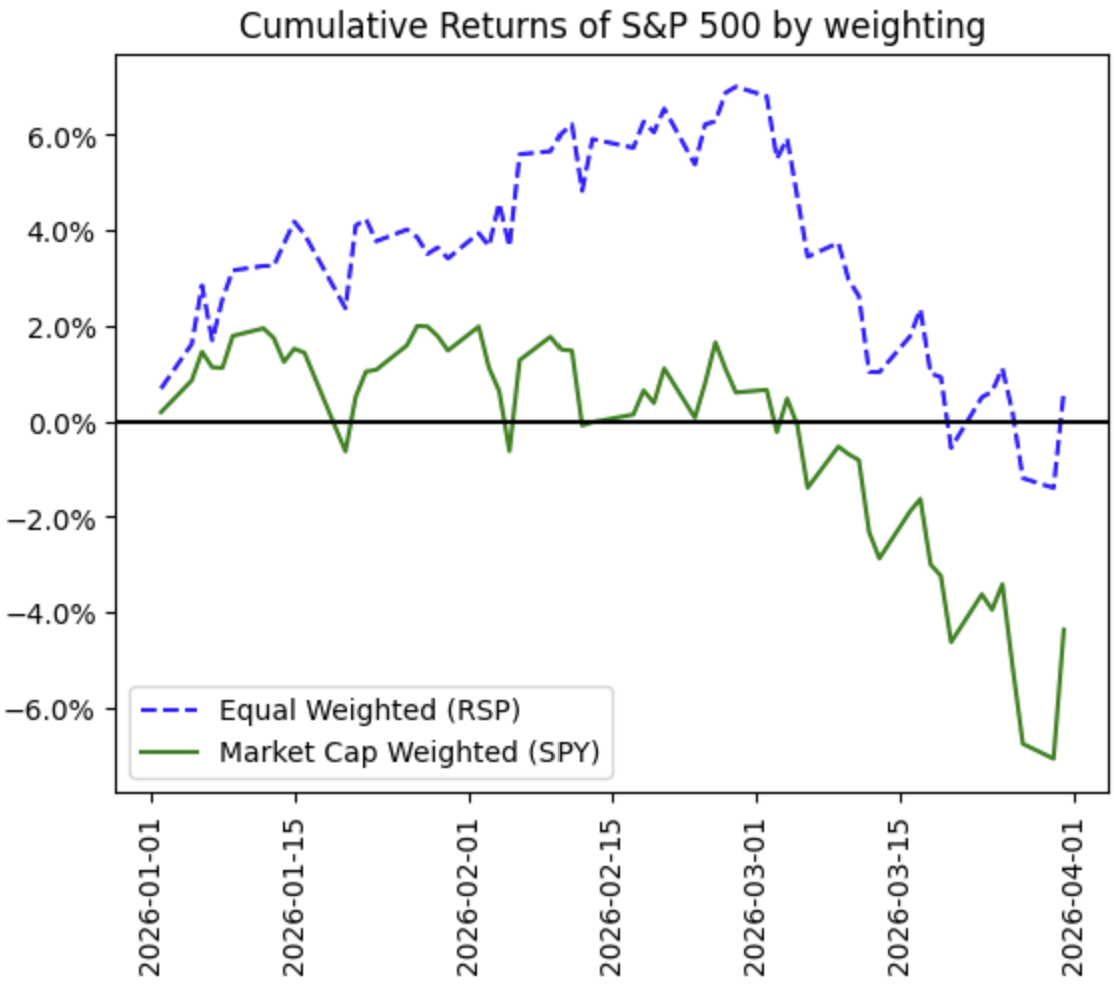
As you can see from the plot below, the S&P 500, when measured on a market cap weighted basis (SPY), has had negative cumulative returns since March. In contrast, the equal weighted S&P 500 (RSP) has mostly maintained positive cumulative returns. RSP dipped into negative cumulative returns towards the end of March, but thanks to a rebound of over 2% on the last day of the month, it returned to positive territory. On the other hand, the SPY is still down over 4%.
Style Factor Signals
Large-Cap Style
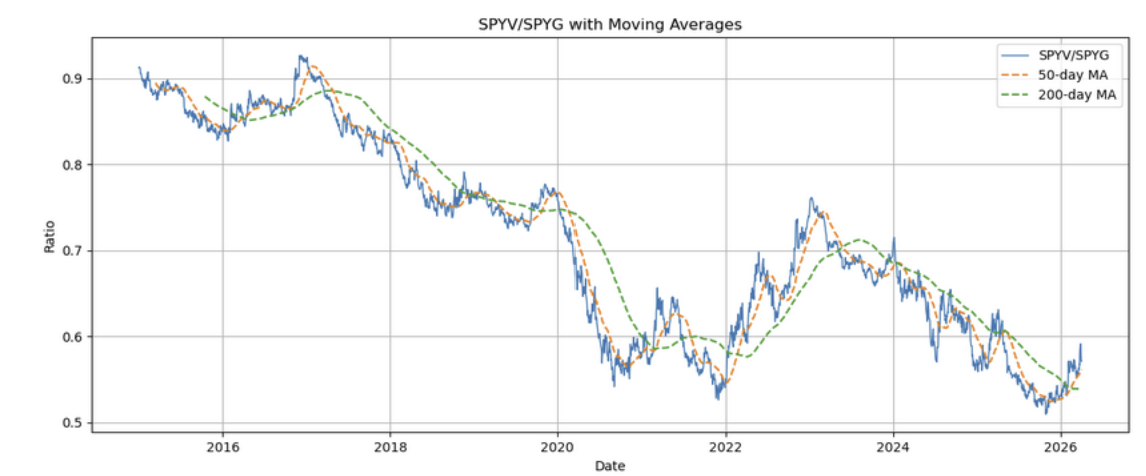
Within large-cap, while growth is still the dominant trend, it continues to weaken, and value continues to break out. Note the spike in the blue line in the plot above in February and the second spike in March. This is consistent with the relative underperformance of the market-weighted S&P relative to the equal-weighted S&P.
SMID Style
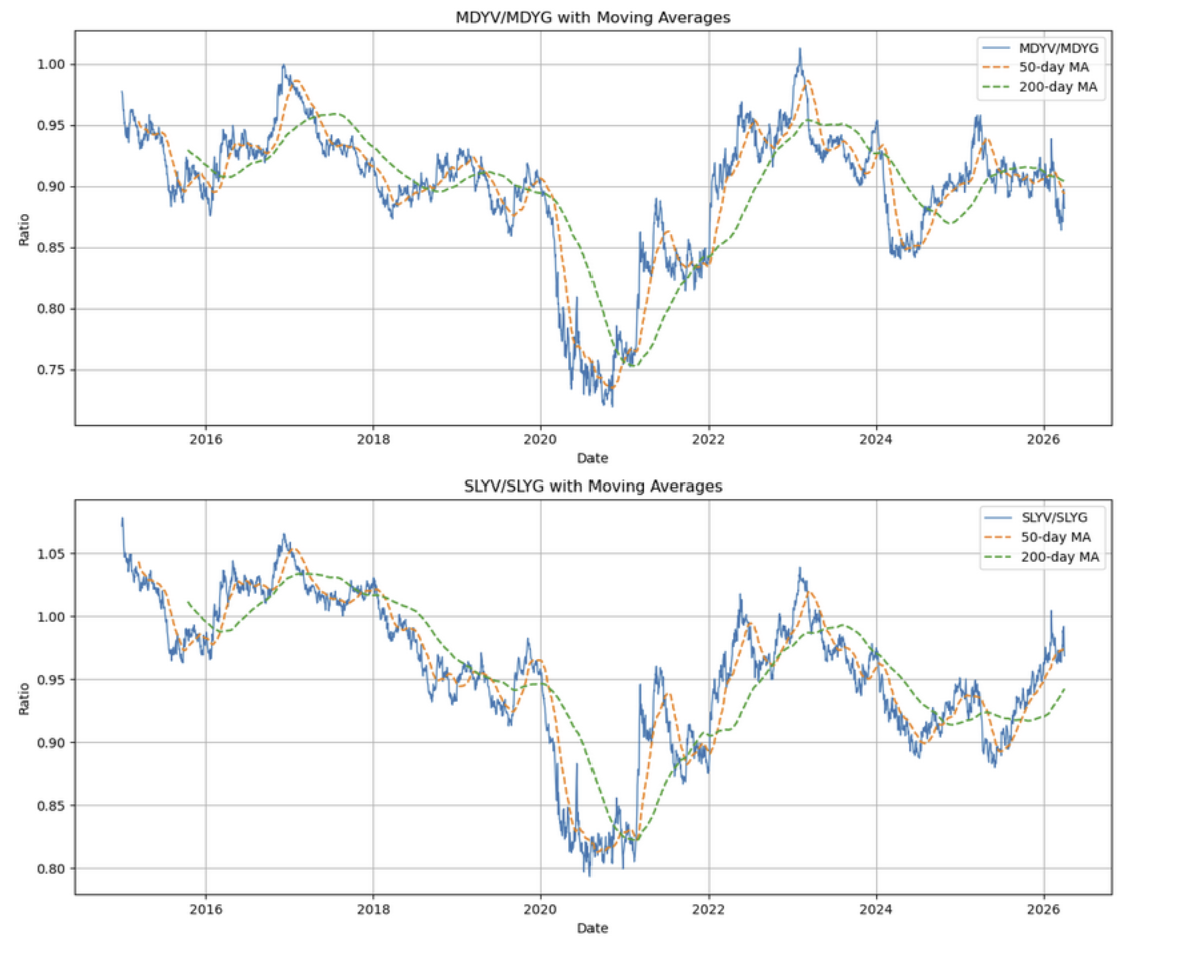
Within non-large stocks:
- Mid-caps continue to exhibit a more neutral value/growth profile. Mid Blend was a positive contributor to stock selection while growth and value were detractors.
- Small-caps continue to favor value over growth, though small growth was a leading contributor to the strategy's returns while small value was a detractor.
Stock Selection
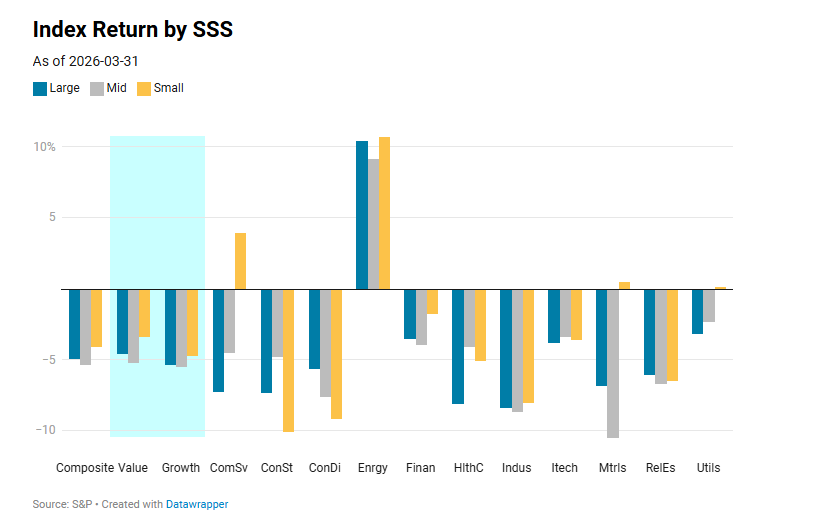
Stock selection helped offset some of the losses in March. Our signal was generally effective on both the buy and sell sides, bolstering returns and helping avoid underperformers in many instances. Mid blend constituents earned a positive return. The most stellar performer was Targa Resources Corp, which is an energy infrastructure company. It was up 6.3% in March. As you can see from the plot below, this is consistent with the broader market trend, where the energy sector is the only sector with positive returns across large, mid, and small.
Long-Term Performance (GIPS Composite)
In March, the strategy yielded a negative return, which was consistent with the broader market environment and the return of the benchmark. However, on a year-to-date basis, the strategy is outperforming the benchmark. Over the short-term (1 to 3 years) the strategy lags the benchmark. During much of this period, the large-caps drove overall returns, while the strategy typically performs better in broader markets.
Compliance Disclosure:
The Size and Style Responsive (SSR) Tax Aware strategy includes all institutional and retail portfolios that invest in a portfolio of stocks in large, mid, and small cap companies. The strategy seeks to manage after-tax returns by incorporating tax considerations into trade decisions. For example, when possible, the strategy may defer realizing short-term gains to achieve long-term tax treatment, subject to client-specific constraints and objectives. Tax impact is a factor in implementation, but it does not override the strategy’s investment objectives.
Burney Advisor Services affirms compliance with the Global Investment Performance Standards (GIPS®) and has prepared this chart in accordance with these standards. As of February 2, 2026, the benchmark for the SSR Tax Aware shifted from the Russell 3000 Index to the S&P 1500 Index, and this change applies to all reporting periods. The characteristics of the equity holdings in the S&P 1500 Index better match those of the SSR Tax Aware than those of the Russell 3000. The S&P Composite 1500 Index combines stocks in the S&P 500, the S&P MidCap 400, and the S&P SmallCap 600. The inception date of the strategy is March 1, 2018.
Past performance, whether actual or hypothetical, does not guarantee future performance. Investment results and principal value will fluctuate, and clients' investments, when redeemed, may be worth more or less than their original cost. This communication is exclusively for investment advisors and financial professionals and is not intended for clients or the investing public.