
Content
A Brief Anecdote
Why Invest In Private Equity
Implementation Challenges
Why Now?
Conclusions
A Brief Anecdote
Today the NASDAQ fell more than 2.3% in early afternoon trading, partly driven by a selloff in software stocks after AI startup Anthropic released a productivity tool for in-house lawyers, sending shares of legal software and publishing firms lower.
This is not the first time Anthropic has surfaced in market headlines. Last week, Microsoft (MSFT) fell roughly 10% after earnings despite beating both revenue and profit estimates — its largest one-day decline since 2020. In areas such as enterprise automation, AI workflows, and AI coding tools, Anthropic’s Claude is increasingly viewed as a credible threat, offering high-quality capabilities, sometimes at a fraction of the cost.
“If you can’t build it, integrate it.” In September 2025, Microsoft began integrating Anthropic’s Claude models into Microsoft 365 Copilot. The partnership expanded further in November 2025, with Claude models becoming available in Microsoft Foundry.
So what is this company, Anthropic, and can investors buy its stock? The answer is no — Anthropic is a private company and is not publicly traded.
Why Invest In Private Equity
The fundamental principle of investing is to participate in the growth and value creation of companies—and, by extension, the broader economy. Limiting portfolios to public equities leaves substantial value on the table.
This is especially true today, as AI-driven innovation is accelerating rapidly and an increasing share of innovation is being funded privately. Many of the companies shaping this new economy are still privately held, creating compelling opportunities for investors beyond the public markets.
A (Much) Bigger Pond to Fish
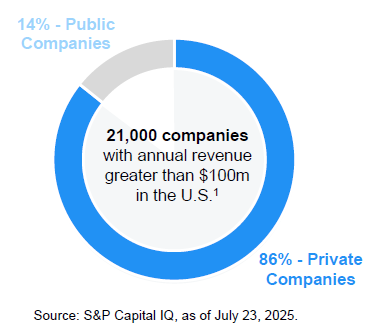
The sheer number of private companies is massive. As of December 2024, there are approximately 730,000 U.S. firms with 20+ employees, of which only about 4,000 are publicly listed. Even among firms with revenues exceeding $100 million, just 14% are public.
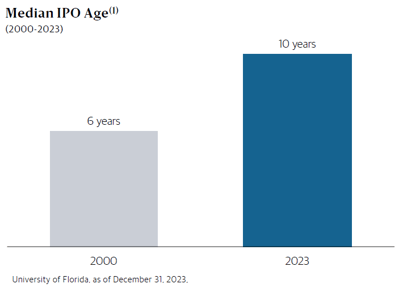
Private companies are also taking longer to go public due to abundant liquidity. Substantial growth and value creation now occur in private markets, and the pipeline delivering high-quality small-cap stocks to public markets—historically a key driver of company growth and stock returns—has thinned.
Maybe Catch A Unicorn?
Anthropic, the AI startup mentioned above, is expected to turn profitable in 2028 and is reportedly in early IPO talks that could value the company at more than $300 billion. At that size, it would enter public markets as an instant large-cap, with much of the value creation already captured by private investors—including Fidelity, BlackRock, Blackstone, Google, Amazon, sovereign wealth funds such as Singapore’s GIC and the Qatar Investment Authority, and most recently, Sequoia Capital.
Similar to Anthropic, SpaceX is also looking at an IPO valued at north of $800 billion. Companies that are backed by private equity and valued above $1 billion are known as “unicorns.” During 2020–2021, accommodative financial conditions pushed private valuations higher, accelerating unicorn formation. After 2022, a more challenging exit environment reduced IPOs and M&A activity, keeping companies private for longer. Together, these dynamics have led to a larger universe of unicorns than in the past, making private markets increasingly difficult for investors to ignore without risking missed opportunities.
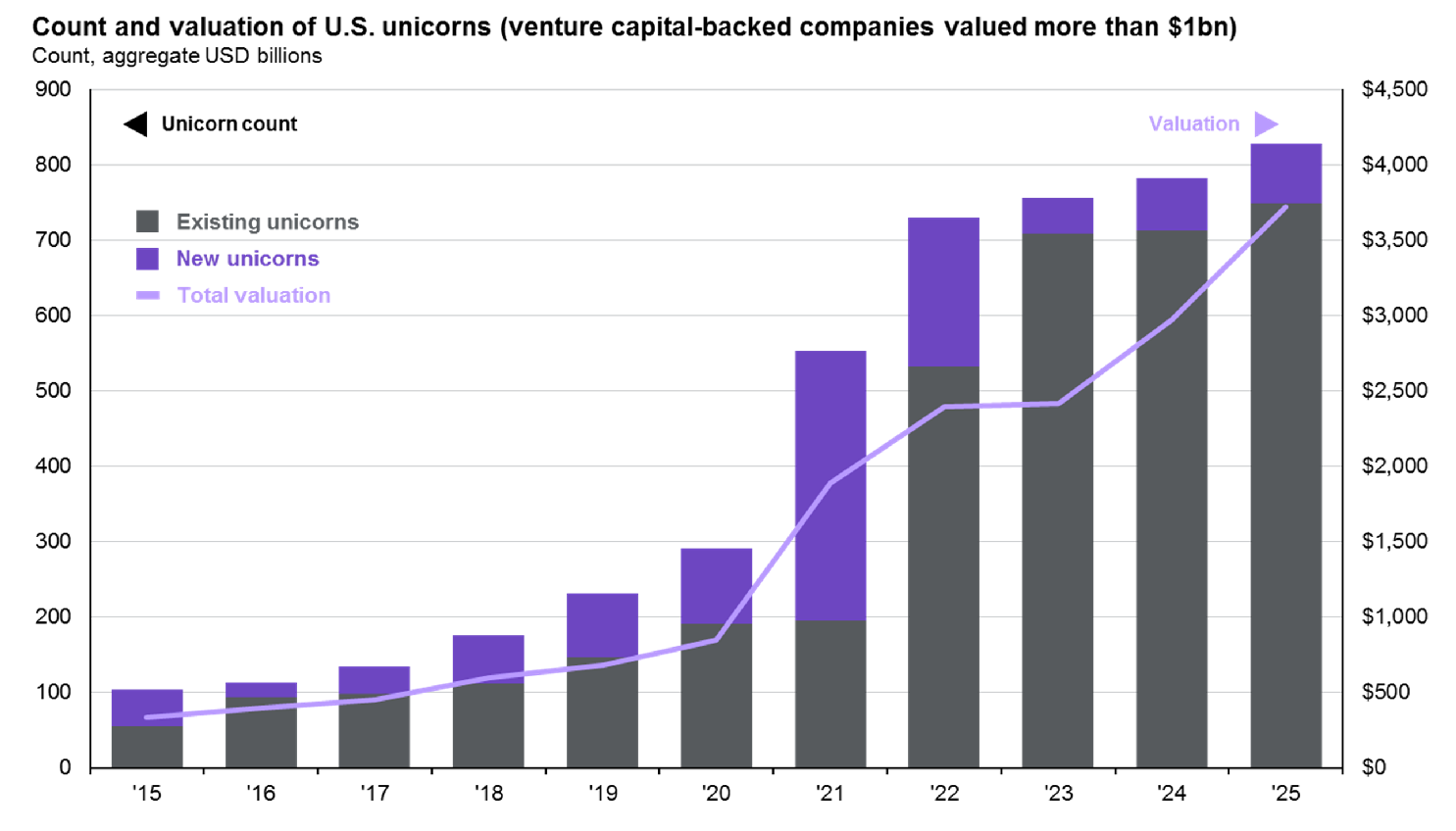 Source: PitchBook Data, Inc, J.P. Morgan Asset Management.
Return Potentials
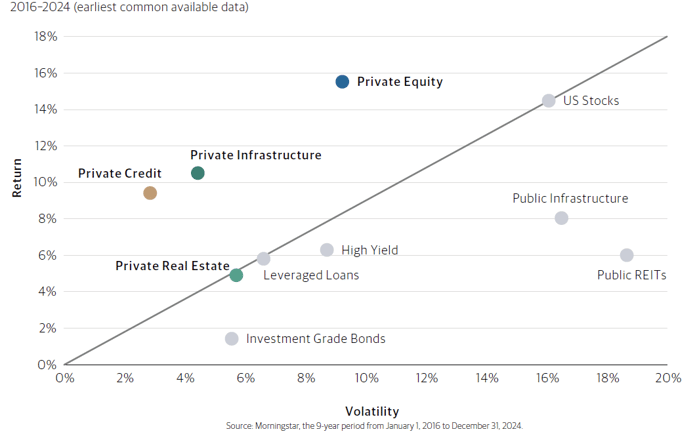
Investing in private equity does not automatically guarantee the opportunity to find a successful unicorn, and as in public markets, there are always both good and bad investments. However, across full market cycles, private equity has collectively generated excess returns relative to public equities — roughly 5% annualized over the past twenty years — while experiencing fewer negative-return years and shallower drawdowns during periods of market stress, including the Global Financial Crisis and 2022.
This relative outperformance is primarily driven by structural characteristics of the asset class:
- Active ownership with direct operational influence
- Long-term focus rather than the next quarter
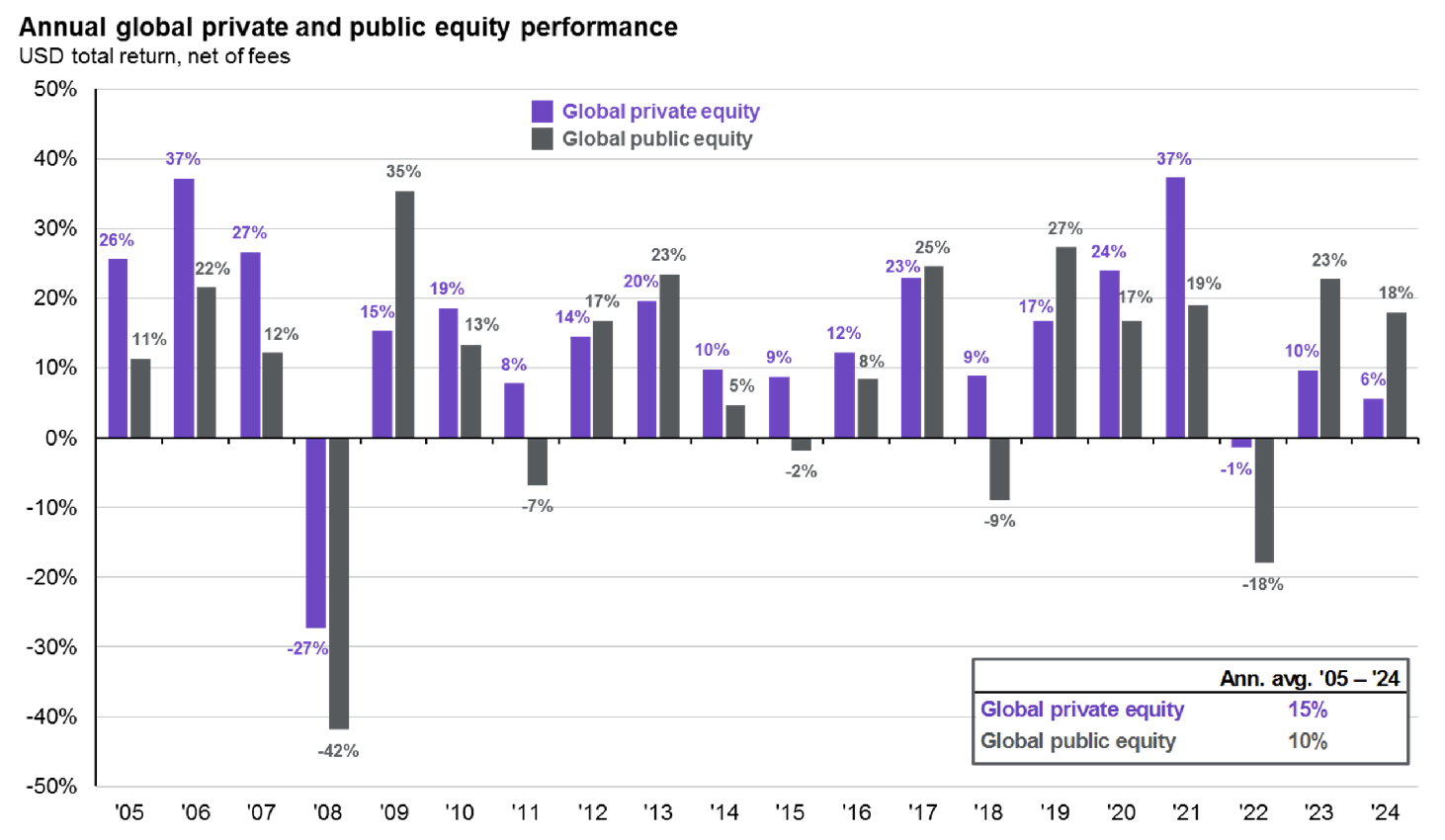
Source: Burgiss, FactSet, MSCI, J.P. Morgan Asset Management.
Diversification Benefit
The combination of higher long-term returns, lower reported volatility, and less severe drawdowns results in stronger risk-adjusted performance — a characteristic that enhances portfolio diversification and supports the case for private equity in strategic allocations.
Implementation Challenges
Not For All Investors
While pension funds and endowments have long embraced private equity, the asset class presents meaningful challenges for non-institutional investors. Long lock-up periods, limited secondary liquidity, uncertain capital calls, higher fee structures, and opaque holdings complicate cash-flow planning and obscure both the timing and magnitude of returns. These characteristics historically demand patient capital, sophisticated liquidity management, and professional oversight, making private equity challenging to access and implement effectively for non-institutional investors.
Performance Dispersion
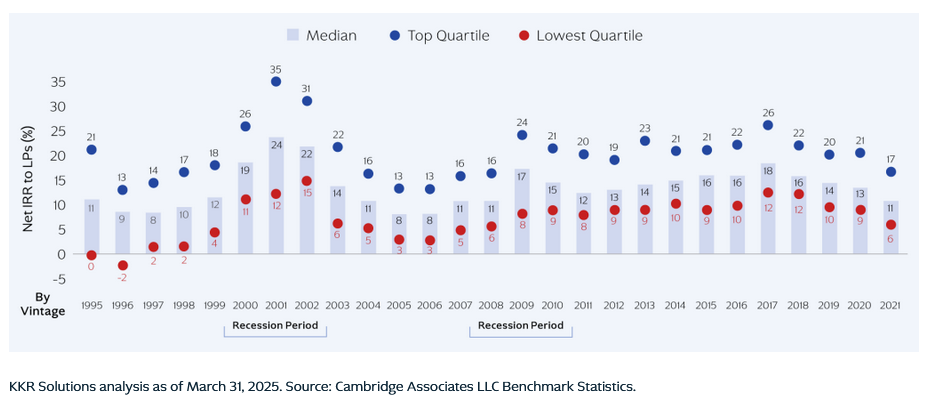
Similar to the public markets, alpha generation in private equity is uneven across managers. But in the private space, the performance dispersion is significantly wider. According to KKR, the historical return gap between top-performing and bottom-performing private equity managers is approximately 14%, underscoring the importance of manager selection.
Why Now?
AI Opportunities
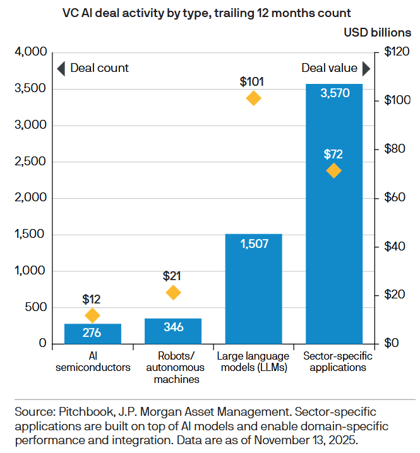
The accelerating development and adoption of AI may be ushering in a new era of entrepreneurship. While investors have a wide range of public companies to consider within the AI theme, some of the most compelling growth opportunities may lie in smaller, private firms.
Evergreen Funds
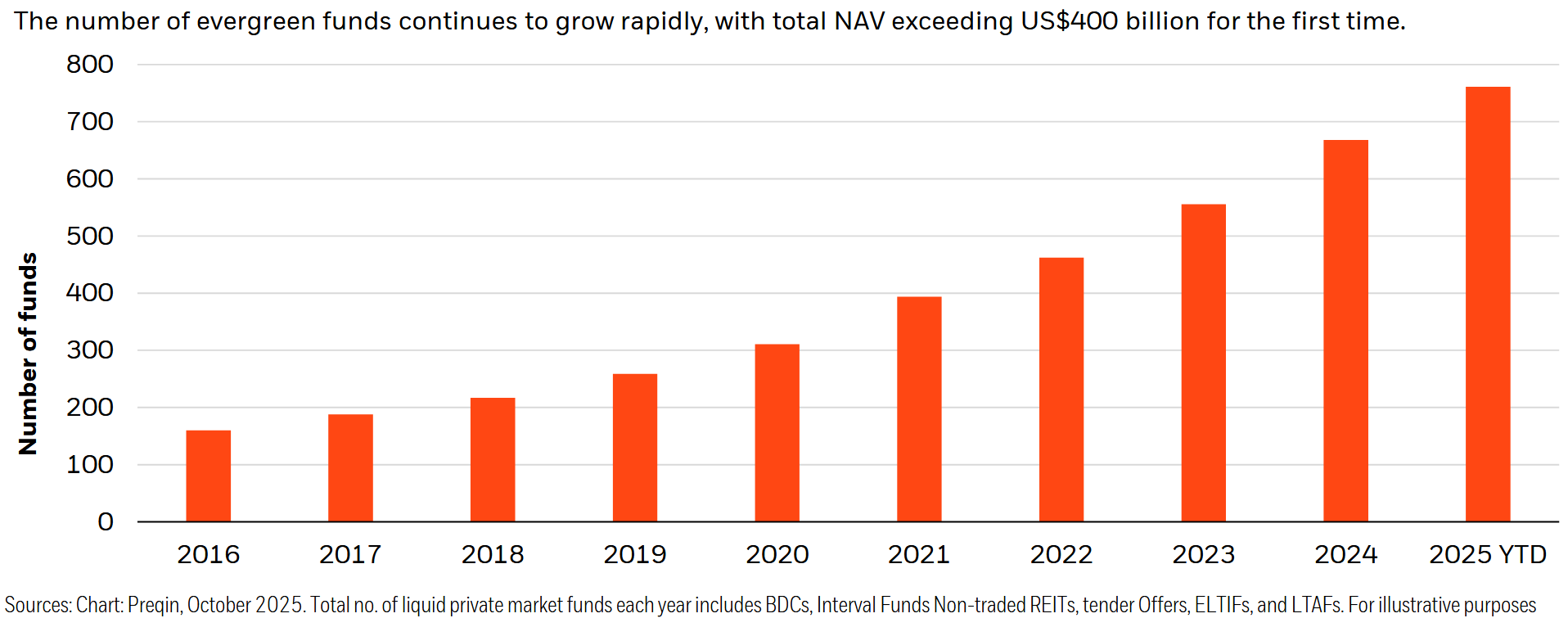
Recently, the private equity industry has seen meaningful financial innovation aimed at addressing traditional barriers. Fees have been coming down due to increased competition, and there is a rising trend of evergreen or semi-liquid private equity vehicles, making private equity more accessible to investors.
Evergreen funds still have gates and restricted liquidity, but investors can request redemption on a quarterly or semiannual basis. These funds deploy capital continuously and, to a great degree, can help reduce the J-curve effect.
Entry Point
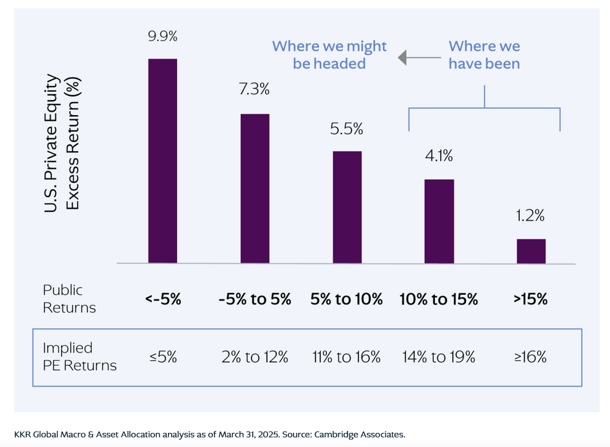
Over the past three years, public equities have significantly outperformed private equity, creating a meaningful performance gap. Historically, returns across public and private markets tend to converge over time, suggesting a potential mean reversion opportunity as private equity catches up in future cycles. As a result, the current environment may offer an attractive entry point for investors seeking long-term exposure to private markets.
Conclusion
Private equity offers investors access to a much broader universe of companies than public markets, including high-growth firms that may not go public until much later in their lifecycle.
While the asset class has historically delivered attractive long-term return potential and diversification benefits, it also comes with meaningful implementation challenges such as illiquidity, capital call uncertainty, wide performance dispersion across managers, and complex cash-flow planning.
Recent innovations—particularly evergreen and semi-liquid fund structures—are helping expand access and improve flexibility for a wider range of investors. Combined with the recent performance gap between public and private markets, today’s environment may represent a compelling opportunity for long-term investors to consider private equity exposure as part of a strategic allocation.