
Tax-Aware Long Short Strategies Don't Pay for Themselves.
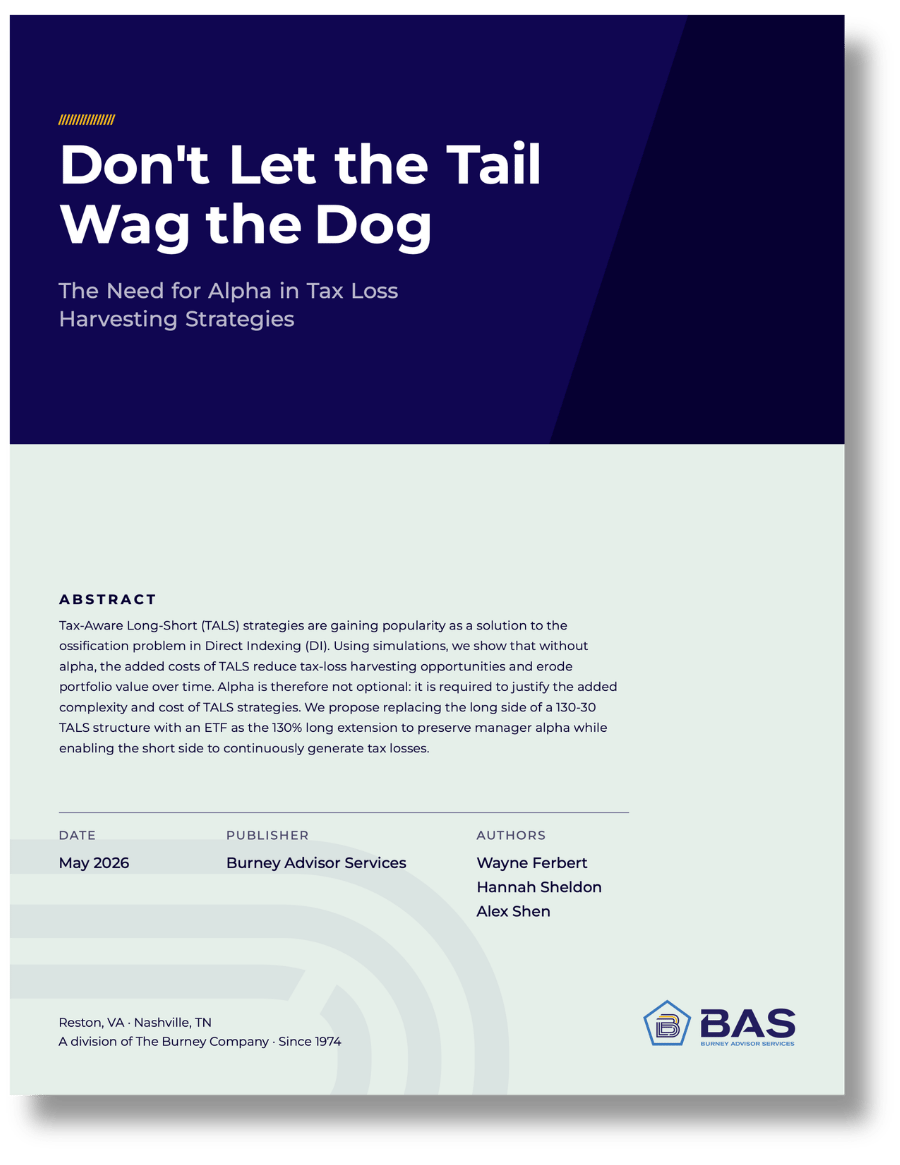
Download our new white paper. Learn why alpha isn't optional in TALS strategies and how an ETF wrapper can change the math.
*For investment advisers and institutional investors only.
Your Clients Are in TALS.
But Does the Math Work?
Tax-Aware Long-Short (TALS) is one of the fastest-growing categories in separate account management. Brent Sullivan from Tax Alpha Insider estimates net assets in the space grew from $20B at year-end 2024 to more than $150B by April 2026. Advisors are using these strategies to generate tax losses for clients, and the pitch sounds compelling.
But many TALS strategies don't break even.
After fees, margin financing, and the long-side ossification baked into the structure, the tax benefit in a 130-30 Direct Indexing portfolio often isn't large enough to offset the portfolio's shortfall relative to the benchmark. Your clients may be paying a premium for tax alpha that isn't there.
This paper quantifies what that gap looks like and what to do about it.
|
In many cases, the strategy does not pay for itself. The tax benefits are often insufficient to offset the loss in the ending portfolio value relative to purchasing the benchmark itself. Without alpha, the math simply does not work. - "Don't Let the Tail Wag the Dog" |
What You'll Learn in 17 Pages
01
|
02
|
03
|
04
|
Burney Has Been Doing This Since 1974.
Wayne Ferbert, Hannah Sheldon, and Alex Shen authored this paper at Burney Advisor Services, a division of The Burney Company. Burney has been a registered investment adviser based in Virginia since 1974.
The simulation runs across 17 overlapping 10-year windows from 2000 to 2025, using actual price returns from the S&P 500 universe. All assumptions are disclosed in the paper, and the full methodology is available on request from the authors.
This paper was written to inform manager selection and client recommendations.
|
#4 Advisory Firm in the U.S. · #1 in Virginia (2025 CNBC FA100) |
Top 1500 Independent Advisors (Barron's 2014–2026) |


Complete the short form. You'll get the paper immediately, plus a follow-up email with a permanent download link.
| ✓ |
Takes 30 seconds. Name, email, and a professional confirmation. |
| ✓ |
Covers direct indexing, 130-30 tax-aware long short strategies, alpha scenarios, and the ETF wrapper structure. |
| ✓ |
All assumptions disclosed in the paper itself. |
| ✓ |
Research you can use to make better decisions for your clients. |
| ✓ |
Full methodology details available upon request from the authors |

Advisory services are offered through the Burney Company, an investment advisor registered with the U.S. Securities & Exchange Commission. SEC registration does not constitute an endorsement of the firm by the Commission nor does it indicate that the advisor has attained a particular level of skill or ability
CNBC’s annual FA 100 ranking was published on 10/1/2025 for the year 2025. The Burney Company did not pay CNBC any compensation for being considered for the list, however, Burney Company does pay a licensing fee to use the CNBC logo in marketing materials. A link to the CNBC selection criteria can be found by going to https://www.cnbc.com/2025/10/01/financial-advisor-100-methodology-2025.html. The CNBC award was given to The Burney Company, which includes portfolio managers associated with Burney Wealth Management and nine other affiliated portfolio managers.
Barrons Top 1200 ranking was published on 3/10/2026 for the year 2026. The Burney Company did not pay Barrons any compensation for being considered for the list, however, Burney Company does pay an annual fee for access to its “Digital Marketing Package” that provides Burney with an upgraded online profile. A link to Barrons selection criteria can be found by going to https://www.barrons.com. The Barrons award was presented to Burney President Lowell Pratt.
Advisory services are offered through the Burney Company, an investment advisor registered with the U.S. Securities & Exchange Commission. SEC registration does not constitute an endorsement of the firm by the Commission nor does it indicate that the advisor has attained a particular level of skill or ability
CNBC’s annual FA 100 ranking was published on 10/1/2025 for the year 2025. The Burney Company did not pay CNBC any compensation for consideration for the list; however, it does pay a licensing fee to use the CNBC logo in marketing materials. A link to the CNBC selection criteria can be found by going to https://www.cnbc.com/2025/10/01/financial-advisor-100-methodology-2025.html. The CNBC award was given to The Burney Company, which includes portfolio managers associated with Burney Wealth Management, as well as nine other affiliated portfolio managers.
Barron's Top 1200 ranking was published on 3/10/2026 for the year 2026. The Burney Company did not pay Barrons any compensation for being considered for the list; however, Burney Company does pay an annual fee for access to its “Digital Marketing Package” that provides Burney with an upgraded online profile. A link to Barron's selection criteria is available at https://www.barrons.com. The Barron's award was presented to Burney President Lowell Pratt.
HYPOTHETICAL PERFORMANCE — IMPORTANT NOTICE
The analyses, charts, and portfolio projections contained in the White Paper are based entirely on hypothetical simulations and modeled outcomes. They do not represent the actual performance of any investment product, account, fund, or strategy managed by The Burney Company or any affiliated entity. No actual client assets were managed using this strategy during the periods depicted. Hypothetical or simulated performance results have certain inherent limitations. No representation is being made that any account will, or is likely to, achieve profits or losses similar to those shown.
130/30 Disclosures:
We execute this strategy at two custodian firms: Interactive Brokers and Schwab. Both custodians offer competitive margin rates vs other custodians. Clients seeking to utilize this strategy will need to sign a margin agreement with the custodian firm. The strategy can only be executed in taxable accounts with a minimum investment of $250k.
The primary risks associated with this strategy include the following:
-
Unlimited risk of loss from short selling. Unlike long positions, where losses are limited to the initial investment, the price of a stock sold short can rise indefinitely, potentially causing rapid and unlimited losses. The Burney Company employs various measures to reduce this risk, but losses can still occur.
-
Leverage and margin risk. Long-short strategies use margin to boost exposure, increasing both potential gains and losses. A decline in stock value can trigger margin calls.
-
Tracking error and portfolio risk. There is potential for tracking error due to the performance of our stock selection model. Success depends on the portfolio manager’s ability to choose both winning longs and losing shorts. Poor timing or incorrect analysis can lead to losses on either side. Additionally, in volatile market conditions, the assumed hedge between long and short positions may break down, leaving the portfolio vulnerable to broad market downturns.
-
Costs and tax implications. This portfolio incurs additional expenses, including margin charges, as detailed in the margin agreement. Additionally, closing out positions can lead to significant short-term capital gains tax liabilities that may not be fully offset.
-
Liquidity risks. Some short positions may become difficult to borrow or cover, particularly in volatile markets, making unwinding difficult.
The strategy is intended for sophisticated investors with aggressive or moderately aggressive risk tolerances who understand its complexity and the potential for unlimited losses associated with short selling. Past performance is not indicative of future results. All investments involve risk, including loss of principal.